
What are brand archetypes?
Brand archetypes are a set of 12 universal, relatable yet fictitious characters developed to help brands connect with consumers on a deeper level. They have been brought to life by Carl Jung in the 40s and have been since then widely recalled in almost all Brand Management Classes of Business Schools.
The idea is simple: by learning which archetypes your brand personality falls into, you can more easily figure out your Brand’s personality and create marketing campaigns and content that resonates with your target audience.
What are the 12 brand archetypes?
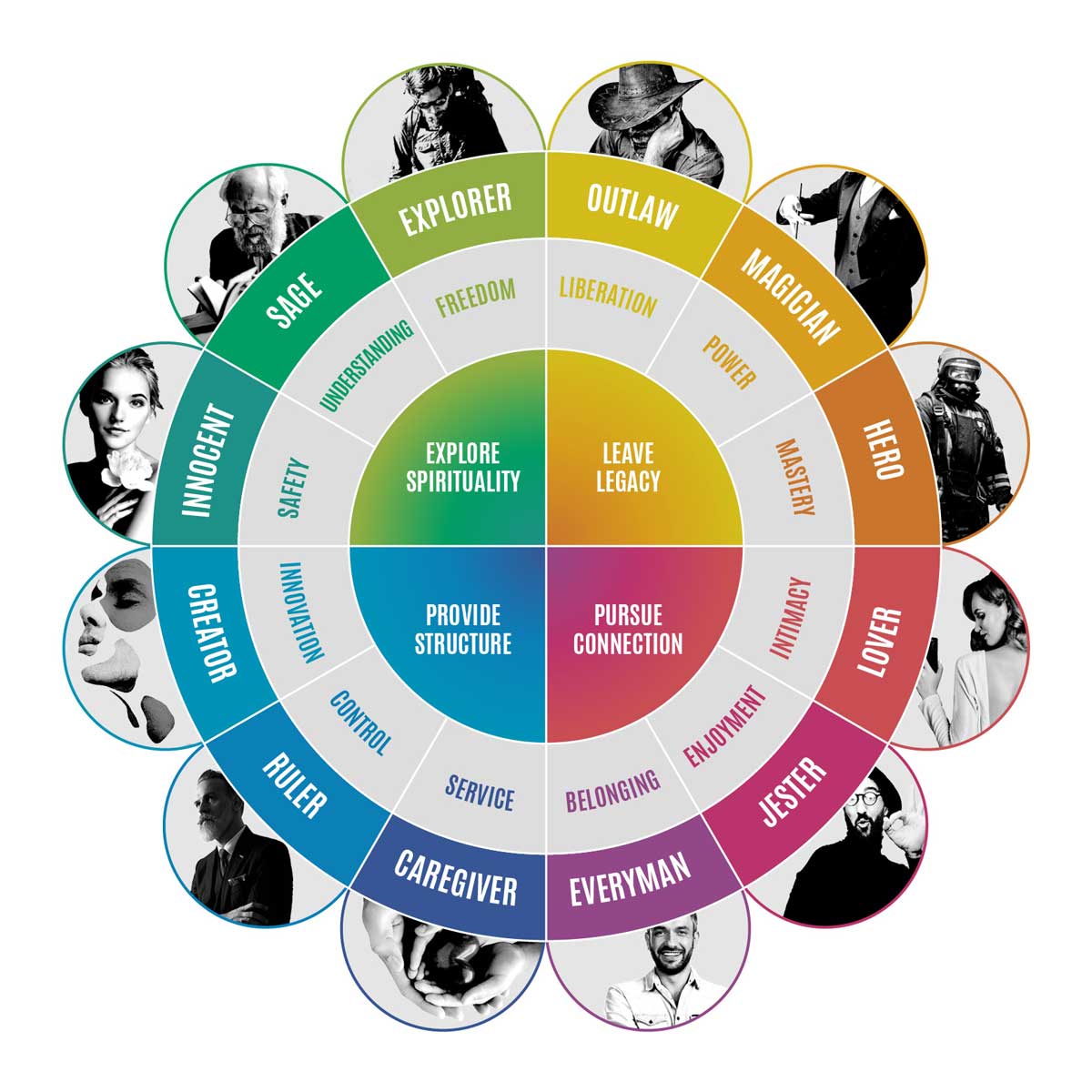
The original theory explains 4 brand archetypes, later expanded to 12 (represented by the image above). Here are the 12:
– The Innocent: The innocent archetype is all about hope, purity, and trustworthiness.
– The Explorer: The explorer archetype is all about adventure, freedom, and discovery.
– The Sage: The sage archetype is all about knowledge, wisdom, and understanding.
– The Rebel: The rebel archetype is all about non-conformity, independence, and defiance.
– The Lover: The lover archetype is all about connection, passion, and intimacy.
– The Creator: The creator archetype is all about imagination, originality, and self-expression.
– The Jester: The jester archetype is all about fun, playfulness, and lightheartedness.
– The Hero: The hero archetype is all about courage, honor, and strength.
– The Caregiver: The caregiver archetype is all about protection, nurturing, and care.
– The Magician: The magician archetype is all about transformation, power, and mystery.
– The Ruler: The ruler archetype is all about control, authority, and prestige.
Those 12 characters have been further expanded by other psychologists and marketers over time, with the intent to better frame and sub-frame one Brand’s personality.
How do you select which Archetype your Brand represents?
You don’t, simple. If have read my piece about the CBBE Model, then you know that as you move upwards the pyramid you have the ability to influence perceptions, but that is, influence not driving them. Hence, the best way I have seen the theory of Archetypes applied is when you ask customers to rate certain attributes and by connecting the results you have a derivative Archetype that should represent your Brand.
Most likely though, the different scores won’t add up to just one Archetype, but a combination of 2 or even 3, which directly brings me to the next paragraph about my experience using this theory.
My experience with Brand Archetypes? They are not actionable.
At least in the way countless websites are parroting this theory on their blog articles with the intent of scoring high on SEO. In my experience building both local and global Brands, the use of Brand Archetypes is limited to informing your marketing agency when building content for the first time, especially regarding Tone of Voice. In that case, and for them only, having widely recognized models as a base to develop content can actually steer them on a more aligned path. But other than that, especially with today’s ability to perform A/B tests, build personalized customer journeys through sophisticated CRMs implementations, and identity resolution via CDPs, I have never found the Archetypes theory any applicable in practice.
When you hear someone at your company saying: “We can’t say that, we are a “Sage”!”, you better make a break, offer them a coffee and move on to bringing back data to the discussion. Seriously, the theory holds valid for what it is (a theory) but the personality attributes and how they compare relative to your competition is what matters for your positioning.
So why is it important to look for a brand personality?
Every Brand wants to play a role in the market, shaped through the various marketing levers you can activate, and if correctly played it helps you better connect with your target audience over time. This point though can’t and shouldn’t reach the limits of nonsense as unfortunately happens in some marketing departments: at the end of the day, your positioning is first of all relative to competitors and not acquired per se. Second, I would rather spend time analyzing what customers want, what they find relevant in your competitors’ that you don’t have and let them shape an idea of you as a Brand that you just leverage and politely augment. Saying “We are this and that” and insistently trying to push that idea through, completely defocus your whole marketing department and sucks marketing budgets.
People react to what you do and how you do it (Salience), then they form an opinion in their minds.